
Explainer · August 6, 2026 · 5 min · By Stellan Cho
Why the Filler Itself Matters Under the Eyes: G Prime, Cohesivity, and Water Uptake in Plain English
Not all hyaluronic acid gels behave the same way in the tear trough. Here is what the rheology labels actually mean, and why the wrong gel in the right hands can still cause puffiness.
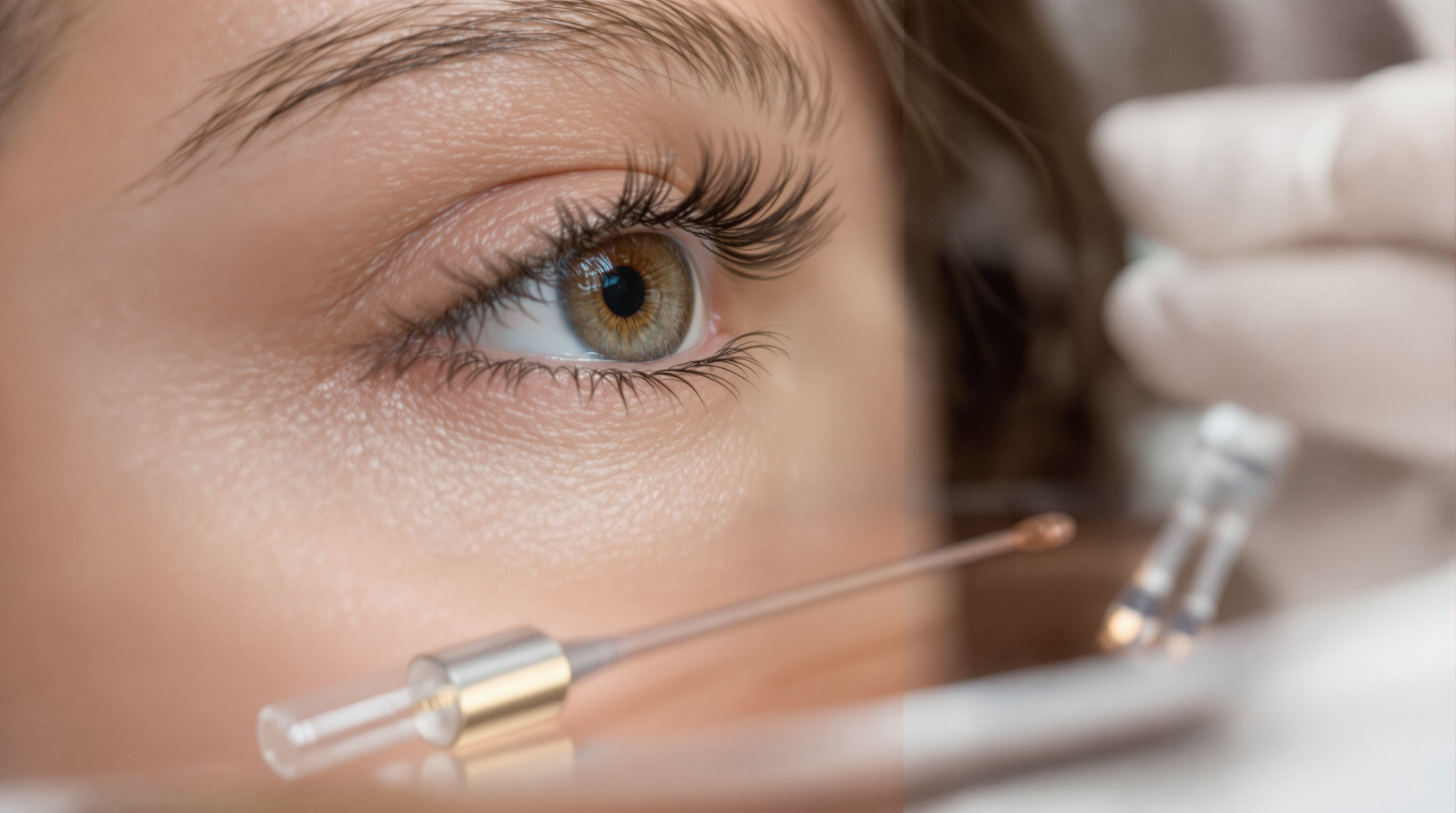
Most conversations about under-eye filler focus on the injector, and for good reason. But there is a second variable that gets far less attention from patients: the physical behavior of the gel itself. Two syringes can both say hyaluronic acid on the box and still act completely differently once placed under the thin skin of the lower eyelid. Understanding three properties, G prime, cohesivity, and hygroscopy, explains most of the puffiness, lumpiness, and blue discoloration complaints that follow tear trough treatment.
G prime: how firm the gel is
G prime, written G', is a lab measurement of a gel's elasticity, essentially how much it resists deformation when pressure is applied. High G prime gels are firm and hold their shape, which makes them useful for building structure in the chin or jawline. Low G prime gels are soft and spread more easily.
The tear trough sits under some of the thinnest skin on the body, often less than a millimeter thick. A firm, high G prime gel placed superficially there can remain visible as a ridge or bead, because there is almost no soft tissue above it to camouflage the product. This is why most injectors working in this area choose softer, lower G prime formulations, or place firmer products only deep on the bone, where overlying muscle and fat can mask them.
Cohesivity: how well the gel holds together
Cohesivity describes how strongly a gel sticks to itself. A highly cohesive gel stays as one unit and resists fragmenting. A less cohesive gel disperses and integrates into surrounding tissue more readily.
Under the eye, moderate cohesivity is often the sweet spot. A gel that integrates too readily may spread beyond where it was placed, softening the correction but sometimes drifting toward the cheek or the eyelid margin with repeated muscle movement. A gel that is extremely cohesive stays put, which sounds ideal, but it can also sit as a discrete, palpable mass if placed in the wrong plane. Neither behavior is a defect. Each is a design choice matched to a purpose, and the purpose has to match the anatomy.
Hygroscopy: how much water the gel pulls in
Hyaluronic acid is naturally hydrophilic, meaning it attracts and binds water. Different manufacturing processes, crosslinking methods, and HA concentrations change how much swelling a gel undergoes after injection. A product with high water uptake can look fine on the treatment table and then swell noticeably over the following one to two weeks.
This matters more under the eyes than almost anywhere else, because the periorbital region already has sluggish lymphatic drainage. Fluid that accumulates there clears slowly. High water uptake gels placed in patients with baseline puffiness, allergies, or a tendency toward morning eye swelling can produce persistent malar edema, the soft, boggy fullness over the upper cheek that worsens with salt, alcohol, and lying flat. This is one of the most common reasons patients seek dissolving with hyaluronidase, and it is often a product selection issue rather than a placement error.
Why superficial placement plus the wrong gel causes blue discoloration
The Tyndall effect, the bluish or grayish tint sometimes visible after tear trough filler, is an optical phenomenon. When particles of gel sit close to the skin surface, shorter blue wavelengths of light scatter off the material more than longer wavelengths, producing a blue cast. Thin skin plus superficial product is the recipe. Softer gels placed deep, on or near the periosteum of the orbital rim, largely avoid this. It is another example of how depth of placement and gel behavior interact: the same product can be invisible at one depth and obvious at another.
What patients can reasonably ask about
You do not need to memorize rheology charts, but a few questions are fair game at a consultation. Which product is planned for the tear trough specifically, and why that one? Is it a softer gel designed for thin-skin areas? How does the injector handle patients with baseline under-eye puffiness or fluid retention, and would they decline treatment in that case? A thoughtful answer will reference the anatomy and the gel's behavior, not just a brand name.
The bottom line
The under-eye area punishes mismatches between product and placement more than almost any other facial zone. Firm gels placed shallow show as ridges. Water-hungry gels in swelling-prone patients cause chronic puffiness. Superficial product of any kind risks a blue tint. None of these outcomes means filler is inherently bad in this region. They mean the tear trough demands a specific tool used in a specific plane, and that the syringe label is doing more work than most patients realize.
Related reading: Why Under-Eye Filler Sometimes Looks Puffy Months Later: The Science of Water, Gel Stiffness, and Lymphatics.
Further reading: Revolutionizing tear trough rejuvenation: A novel bilaminar approach with differential rheologic G prime fillers (Indian J Ophthalmol 2026); Innovative approach for tear trough deformity correction using higher G prime fillers for safe, efficacious, and long-lasting results: A prospective interventional study (J Cosmet Dermatol 2021).